
Stretch factor 1.8X
Coverage MFT

Aperture T2

Focus throw 300 0

minimum focus 2'8.3"0.82M

filter threads N/A

Weight 4.0lbs1.8Kg

size 6.9"17.5CM

get in on B&H
 Anamorphic Lens by Vazen
 Single Focus : Variable Diopter
 Mount: MFT, RF
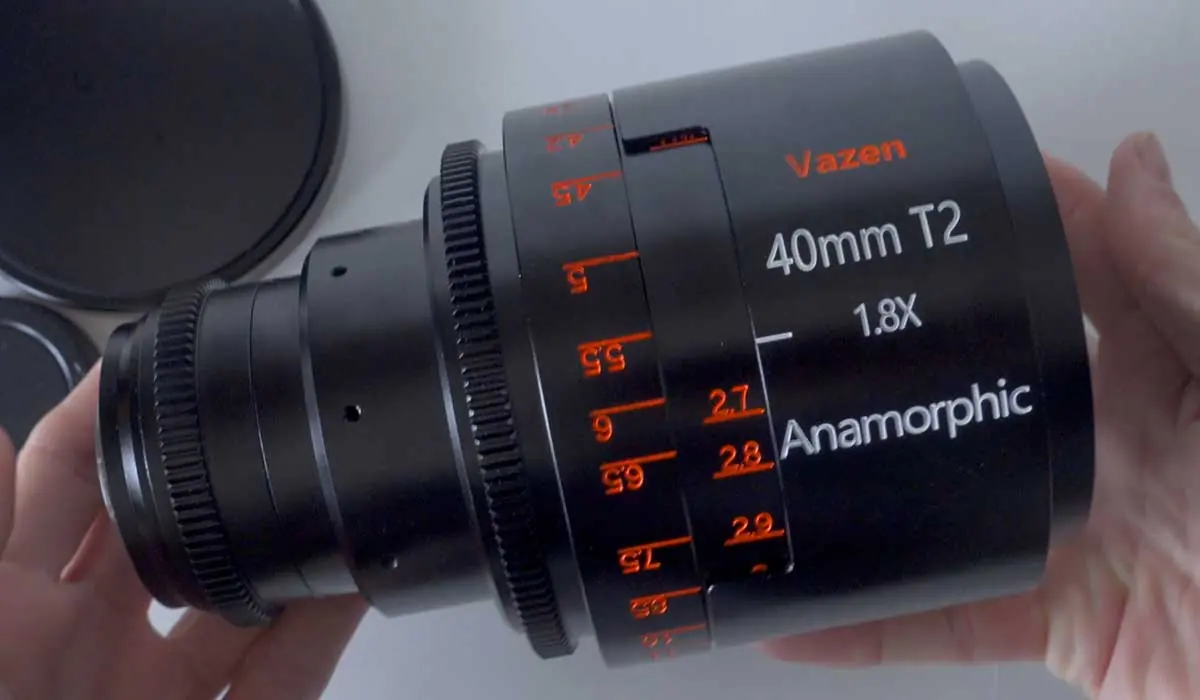
Vazen is a company based in Hong Kong and they first revealed their 40mm lens to the world at 2019’s Cinegear. This is a fully closed lens, call it “cine” if you like, as it has everything a “cine” lens usually has. 40mm is a very versatile focal length and it allowed me to do close ups and establishing shots alike.
The lens weighs 1.8 kilograms or 4 pounds - which is quite heavy! - and it measures 17.5cm or 7 inches from mount to front. Construction is super solid and I’d actually love if this was a little big lighter! Iris ranges from T2 to T16 and focus comes down to 0.8m or 2 foot 7 inches in about 300 degrees of throw. Markings display focus distance in feet and feature bright orange color. Both focus and iris rings are buttery smooth and geared for motors. Oh, and the lens doesn’t change size while focusing and the front doesn’t rotate. I love those things.
The front of the lens has a 95mm outer diameter, which is compatible with lots of clip-on matteboxes. The downside is the lens has no filter threads. Vazen offers an attachment on their website that gives you 95mm threads for $50. With 10 minutes of modeling I 3d printed my own attachment for 86mm threads - which is borderline vignetting.
The mount on the Vazen 40mm is Micro Four Thirds ONLY. This makes this lens even more niche than my own content, severely limiting its user base. On the bright side, they don’t have to deal with e-mount shooters going “how do I desqueeze in camera?”. Any proper MFT camera (by that I mean GH5 5s, Z Cam or Blackmagic Pocket 4K) offers in-camera desqueeze and 4:3 shooting. The GH5 goes as far as offering anamorphic-specific stabilization.
Speaking of anamorphic, this is not a traditional 2x scope. This lens has a squeeze of 1.8x. Why 1.8x of all numbers? Well, 1.8x on a 4:3 sensor will stretch out to perfect 2.4:1 aspect ratio, or Cinemascope, while a 2x lens will give you 2.66:1 aspect ratio. 1.8 squeeze is to 4:3 sensors the same as what 1.33x lenses are to 16:9 sensors: cinemascope machines.
The downside of 1.8x is that alll cameras offer only 2x internal desqueeze, meaning you’ll be looking at the footage a little too overstretched. The only option for proper review on set are monitors that allow you to manually control desqueeze.
For resolution, again I’m doing a bunch of different focus distances with diopters to assess the lens’ performance over the focus range.
At close focus we can see some red fringing when wide open, although the image is pretty sharp. Corners get blurry and there’s some light falloff going on. As we stop it down, light distribution improves considerably.
For mid-range, around 5 feet or 1.5m, wide open seems less sharp and the corners lose sharpness more quickly. There’s some cyan fringing on the corners too.
For infinity I see considerably inferior results across the board, which makes me think the cheap +1 diopter I was using is greatly responsible for the image quality loss moving away from the center.
I’d say the sweet spot for iris on this lens is around f/4, although performance at faster apertures isn’t bad.
Vazen’s flares are nice and blue, super sci-fi, with a handful of streaks. You can also see the teal mirrored flares which are a reflection from the focusing glass.
Starting with bokeh on both edges of the frame shows that there’s some cat-eye/bean shapes going on in those areas, but as soon as the out of focus lights hit center frame they look smooth and have a great shape.
Distortion is pretty pronounced, which I like, especially considering this is a crop sensor. See how the center pops out compared to the edges? This is a strong anamorphic trait and it adds a lot to the look.
On the Sirui review I did a squeeze variation test, checking the stretch factor over the focus range. The Vazen uses a different focusing mechanism based around a Variable Diopter. This ensures the squeeze will remain constant through the rage. The side effect of variable diopters is they tend to have a slight wide-angle effect when comparing the frame at minimum focus and infinity. The Vazen is no exception, and the field of view at close focus is the same as having a 0.9x wide angle adapter.
I still find it a little odd to make such an expensive lens for such a small mount ecosystem as Micro Four Thirds. If you really think about it, the lens is more expensive than any of the cameras it mounts to. Even the S35 Z-Cam with MFT mount costs shy of $3000. Still, Vazen seems to be doing alright which I admire. Footage recently started coming up about their 28mm which shows some big differences from the 40mm design and I’m very curious to test it out too.
I love the build quality and the images it delivers are pretty clean - almost requiring some extra filters to dirty it up a bit. I think the only limiting factor to making this lens a true hit is its mount. Even supporting other mirrorless mounts would do wonders in terms of user base. I’m not talking about EF mount which, again, is out of the question, but e-mounts and x-mounts, which have shorter flanges than MFT.