
Stretch factor 1.8X
Coverage MFT

Aperture T2.2

Focus throw 300 0

minimum focus 2'8.3"0.82M

filter threads 77 MM

Weight 1.6lbs720g

size 4.2"10.7CM

get in on B&H
 Anamorphic Lens by Vazen
 Single Focus : Linear Compensator
 Mount: MFT, RF
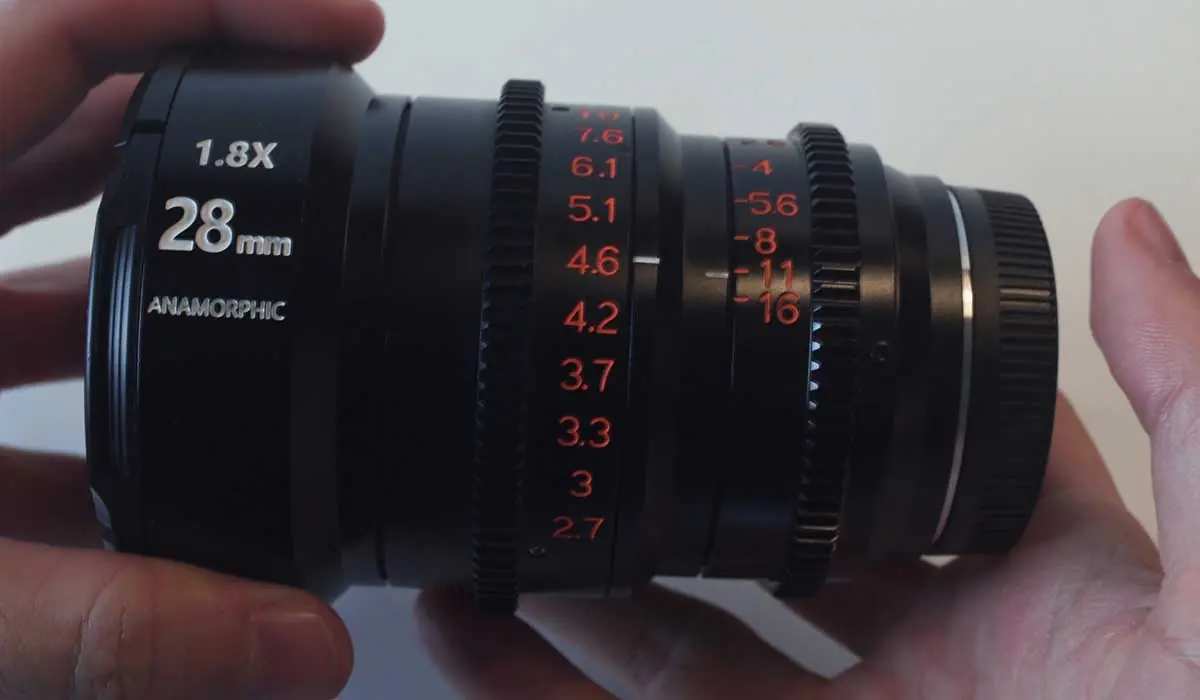
The Vazen 28mm is tiny. It measures 10.7 cm - 4.2 inches - from mount to front and it weights 720 grams - 1.6 pounds. Construction feels super solid and it has that “trustworthy” feel to it. The lens comes only in MFT mount as that is Vazen’s narrow target market. It’s also aimed at folks making use of Anamorphic Modes on their cameras and shooting 4:3; as the 1.8x compression will come out as 2.39 after desqueezing.
Focus throw is 150 degrees, coming from infinity down to 2 foot 7 or 80 centimeters for minimum focus, featuring markings only in feet and on both sides of the lens. The front doesn’t rotate and the lens doesn’t change size while focusing. These two traits combined with its small size and weight make this lens great for gimbal work. Aperture ranges from T2.2 to T16. Both rings are super smooth and I could even ask for a bit more dampness on the iris. Both rings also come with standard gears for motors and have bright orange markings.
The Vazen 28 has 77mm filter threads and 80mm front outer diameter, which makes it compatible with all sorts of cine accessories. This is quite a change from the 40mm which has no filter threads and displays a 95mm front diameter, but even larger body diameter.
Just like the 40mm, the Vazen 28 comes in a nice little case that makes it easy and safe to carry it around. Besides that, there’s very few similarities. Let’s tackle the big question here: WHAT happened between these two lenses that the second one came out so different?
It comes down to how it handles focus. When dealing with anamorphics, there are a few focusing methods: we have Synchro focus, which is what Sirui does along with many older cine anamorphics, it synchronizes focusing for spherical and anamorphic blocks but it suffers from reduced squeeze at close focus. Then we have variable diopter focus, which is like having a built-in Rapido FVD or Rectilux into the front of the system. That’s how the Vazen 40mm works along with some of the Atlas line-up and even the Iscoramas. Variable diopters solve the changing squeeze factor but they add a lot more bulk to the lens. Just look at it. Last, there’s the linear compensator, which is a much more elegant solution than the previous ones, although more complex. This is where this 28mm lands.