
Stretch factor 2X
Coverage MFT

Aperture T2.8

Focus throw 240 0

minimum focus 3'7.3"1.1M

filter threads 82 MM

Weight 3.1lbs1.4Kg

size 7.6"19.2CM

get in on B&H
 Anamorphic Lens by SLR Magic
 Single Focus : Variable Diopter
 Mount: MFT
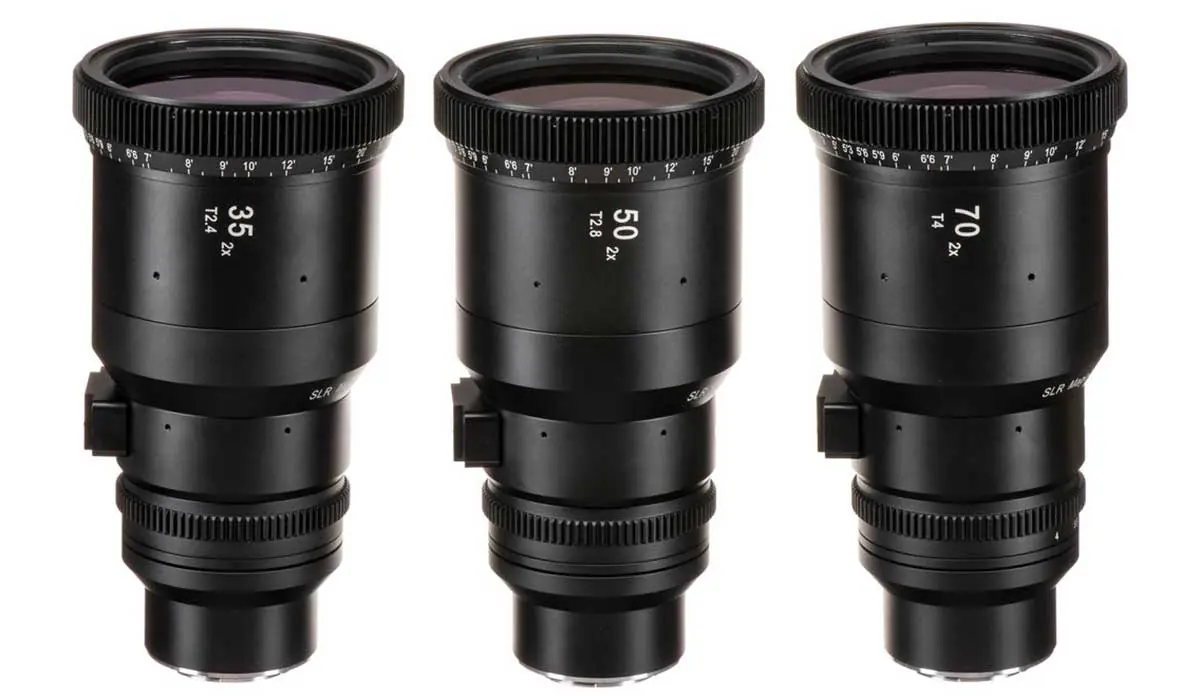
It’s time for SLR Magic Anamorphot CINEs Micro Four Thirds 2x stretch version!
Just like the PL set, the Micro Four thirds trio features a 35, 50 and 70mm focal lengths. I’d make the wild guess that they’re using the same spherical blocks in both sets. While 35, 50 and 70 are pretty standard for shooting S35, they’re a bit on the long side for MFT and the 2x squeeze is what makes this set not feel too tight.
The images have a chromatic-aberration cranked up vibe to me, somewhat reminding me of video, like VHS video, and while their texture doesn’t always scream anamorphic, they definitely don’t look plain.
These lenses come with MFT mounts, and if you got this far without realizing that, I don’t know what to tell you. This means they’re only fit for mirrorless cameras and can’t be adapted to almost anything else.
It’s funny that these are much longer than the PL versions. It’s almost like they just adjusted the flange for MFT. The lenses also feature a support screw hole which is a blessing to avoid getting alignment issues when adjusting focus, due to play on the mount.
Honoring the CINE in the name, as a set SLR Magic got a lot of things right. The lenses all have focus and iris gears, plus the placement of those gears is the same on all three lenses, as well as they share the same size, making it easier to do lens swaps on set without adjusting motors or follow focus back and forth.
The fronts all have 82mm threads which is great for screw-in filters. Minimum focus is a tough one though, at 3ft6, or 1.1m, across the set. While this is okay for the 70mm, it’s not a great thing on the 35mm, where you constantly want to get closer to people, plus the intense MFT crop.
Focusing causes the front element to both rotate and telescope, which means that you can get some crazy polarizing effects if using a variable ND on big focus racks. On the upside, all the focus marks are the same for the three lenses, meaning no need to update your focus wheel after switching lenses.
Exactly like the PL set, the 35mm has a max aperture of T2.4, the 50mm goes to T2.8 and the 70mm is T4. Not the fastest lenses out there, and you’ll see why this makes shooting challenging during the sharpness test.
All the lenses also feature an oval insert to enhance the anamorphic bokeh when shooting wide open. I wonder where they got that idea… It’s interesting to see that these feature an oval, considering they’re 2x lenses. What happens is you get extra skinny bokeh when shooting wide open which I think is something a lot of people can subscribe to.
Looking at sharpness, these are not the sharpest lenses wide open. Not by a mile. You usually have to stop them down one or two stops to get to their sweet spot. We also see plenty of chromatic aberration on high contrast edges. Blue and purple fringing galore.
The flares are standard SLR Magic nuclear blue, with big blue blobs. No surprise here, as these lenses are essentially monoblocks of prime lenses locked at infinity, SLR Magic’s Anamorphot 2x-50 and their Rangefinder variable diopter. No changes in the glass or coatings will lead to the same flares as their adapters.
For coverage, since these are MFT, they aren’t advertised to cover anything else...
For bokeh, the oval insert makes the visuals intense when shooting wide open. We can see the ovals get shorter as we stop down, as the blades cut into that shape. Bokeh in general has a smeared texture to it that I don’t love when analyzing it, but it’s consistent through the set and can help to build unique visuals. It bothers me much less in the actual shots using the lens.
Distortion also affects the bokeh, and we can see it’s pretty strong on the 35mm! The 50mm is a lot cleaner and the 70mm has almost no distortion.
Last, rack focusing introduces some breathing as the Rangefinder works as a wide-angle adapter at the front of the lenses. Just standard procedure here. It’s nice that you gain a bit of field of view when focusing closer.
My main thought about these lenses, both individually and as a set is that they’re still pricier than it should be. Especially with competing options from Vazen and Sirui. But the look is not a boring one. If anything it’s too cranked up, but not necessarily in an anamorphic way. Bokeh, although elongated, feels smeared and the chromatic aberrations throughout the iris range make it for a consistent look that you might not want over completely different projects.