
Stretch factor 1.33X
Coverage 40 MM

Focus throw 60 0

minimum focus 2'7.5"0.8M

filter threads 62 MM

Weight 0.5lbs244g

size 3.1"8CM

get in on B&H
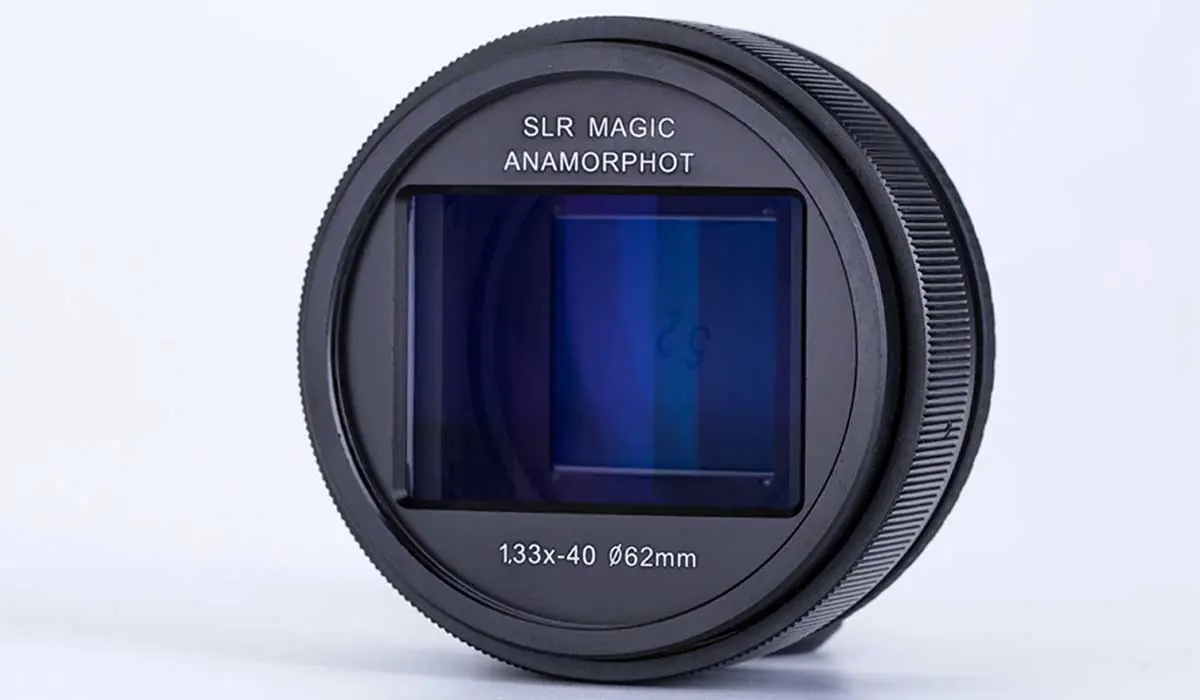
 Anamorphic Adapter by SLR Magic
 Double Focus
 Mount: 52 MM
Readily available.
Square glass elements lead to square bokeh instead of oval
Either the Compact Anamorphot is much better than its predecessors or the taking lenses affected the previous ones a great deal. On this one, for day time I had no issues focusing with any of the tested focal lengths and I was able to quickly find sharpness fiddling with the normal-near ring as well as the taking lens' focus ring. At low light I still got some diamond shapes here and there, but when I found focus, the image sharpened up alright.
The SLR Magic Anamorphot 1.33x-40 Compact - quite a long name, right? - is SLR Magic's THIRD take on a 1.33x adapter. This is the smallest and lightest one yet, at 244g.
It features 52mm threads at the back to attach to various taking lenses and 62mm threads at the front, for smaller (and cheaper!) diopters.
Alignment is set just like the previous version, by reverse rotating the ring on the rear threads until it locks against the taking lens. It's very simple and intuitive and I think it's something that other adapters could use as a reference.
Its design is reminiscent of the Century Optics adapter, with a small body and square optics and focusing done mostly by the taking lens. The difference is while the Century has fixed focus between 4m and infinity, struggling for closer focus, the Compact has the Near/Normal dial which allows you to fine tune your focus range (just like the big Century WS-13). This improves image quality considerably when aiming at objects at close range down to 0.8m. If you wanna get closer than that, I would recommend diopters anyway.
The square glass and lesser squeeze translate into subtle oval bokeh which needs to be pushed through the use of diopters.
The center of the image is pretty decent at any aperture, but the falloff to the edge blurriness is directly related to how stopped down your taking lens is. Wide open, things go blurry rather fast. The Compact is also not a huge fan of longer lenses, and I would cap my range at 85mm.
Did you actually expect NOT to see insanely saturated flares? On some of my lenses, it created this cross-type flare, with very strange edges, and in some others, normal, overly blue streaks.
For sensor coverage, the size of the front optics and how recessed they are on the taking lens matters very much. I got unacceptable results while using a 35mm but the frame cleaned up nicely at 40mm with Canon's pancake. I wanted to test a 50mm just to be sure vignette wouldn't come back due to recessed optics.
| Front Glass Size: | 58 MM |
| Rear Glass Size: | 40 MM |