
Stretch factor 1.33X
Coverage PHONE

Focus throw N/A

minimum focus N/A

filter threads N/A

Weight 0.1lbs40g

size 1.3"3.4CM

get in on B&H
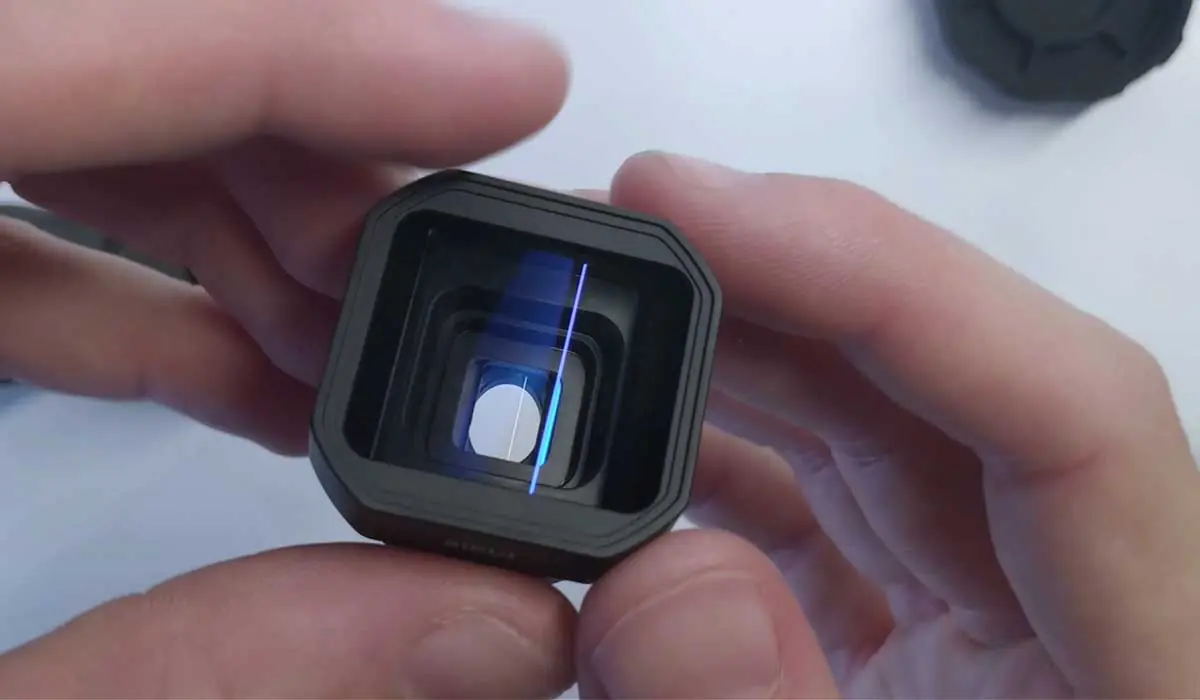
 Anamorphic Adapter by Sirui
 Fixed Focus
 Mount: Bayonet
Anamorphics for phones first came to life in the end of 2013, through a small Kickstarter campaign by Moondog Labs. Their product was so different that there weren’t even apps for desqueezing the image on your phone at that time. “Tangerine” was an interesting movie shot with these lenses.
In 2018 Moment kicks their campaign online. They get funded in 40 minutes, reaching whooping $1.6M and sell almost 10 thousand phone anamorphics.
My theory is that the $1.6M Moment got in funding is the kind of money that motivates a market. Other companies realized there was money to be made from anamorphic lenses for phones and that is what expanded our options. The vast majority of these are 1.33x squeeze, with some very recent expansions into 1.55x by BeastGrip and 1.15x by Ulanzi.
Having options is great, but the inconsistent mounting methods are killing me. While many of them are offered in 37mm or bayonet mounts that fit your phone case, some brands insist on proprietary mounts and I would love to know why.
For beginners considering phone anamorphics as an entryway to shooting scope: these lack oval bokeh and many of the visual traits of anamorphics. You’ll get flares and a wider aspect ratio, maybe some barrel distortion, but that’s about it.
A basic 1.33x lens design has a simple formula: two cylinders that squeeze the image and no focus ajustment. It fails hardcore at close focus and fast apertures. Since our phones have very tiny sensors, the issue with fast apertures doesn’t come to play, only close focus still fails.
Since all these lens makers are using the same anamorphic design the different results come from different coatings. Coatings will determine light transmission, overall tone (warmer or colder), contrast, flare colors and fine resolution.
During my research for making this video I had a really hard time controlling my phone camera until I starteed using the FiLMiC Pro app. FiLMiC Pro gives you everything you have on a regular camera, plus it desqueezes the footage on the fly. It also provides you with zebras, focus peaking and it has great integration with gimbals and other gear. It sells for $12.99.
Then throw on a variable ND for some more light control - make sure your lens can take filters. Not all brands make them, so I made some for the lenses that didn’t have any. The process is the same I used to make the Moment filter holder. To be safe, I carry around a diopter kit too, although I barely use it.
Last, I got a gimbal stabilizer, the Zhiyun Smooth 4, for little over $100. Our phones are crazy sensitive to movement and that translates into the footage as shakiness.
My phone is a Google Pixel 2 and I’m using a Moment case which features a bayonet mount. I had to modify the Kapkur lens from its original bayonet into a standard bayo. The Sirui, MoondogLabs and Moment lenses are all bayo and Ulanzi came in 37mm, so I’m using a clip to secure it to the phone and removing the case.
I’m shooting everything in 4K and desqueezing through FiLMiC, which saves me a ton of time. The final resolution of the files is 3840x1620px. I’m trying, as best as I can to keep shutter at 180 degrees and expose to the right (ETTR), since this tiny sensor noise is awful.
Time to break them with close focus. Here is an attempt at minimum focus. Notice how we finally start to see some bokeh in the background? Do you also notice how it stretches the wrong way? That’s a consequence of fixed focus and having the taking lens - the phone - and the anamorphic focused at very different distances.
In terms of construction, these are all quite similar in terms of size and weight. The square format seems to be more popular, making the lenses more compact. The Kapkur is visibly bigger than the rest and so far it’s the only one that sort of fell apart, with the original bayo falling off - which turned out to be a good thing since it allowed me to remount it as standard bayo.
When it comes to filter threads, none of them offer them natively. Moment sells a filter holder for $30 that is held in place by pressure, Ulanzi sells theirs for $5, and it uses a screw to lock down, Moondog Labs sells for $35 and it features a locking clamp. Kapkur and Sirui don’t make filter holders so you gotta make your own. Mine are locked through a super-tight fit.
All lenses come with front and rear caps, but none of the caps support filter holders - as in, if you want to store the lens with the filter holder attached, figure out your own caps. Moment and Ulanzi give you little pouches that can hold the lens with the filter holder and that was good enough for me.
For the rest of the lenses, I figured a “safe enough” way to transport or took out the filter holder and used the lens caps.
Alignment is a hard thing. Here by far my favorite lens is the Sirui. It has a tiny button that allows you to quickly rotate between vertical or horizontal alignment and since the lens comes in bayonet mount, there’s no need for any adjustments in between these two orientations.
Moment’s has a tiny screw that locks its orientation, so if you wanna switch from horizontal to vertical, all you do is loosen this and adjust.
Moondog Labs and Ulanzi have this ring on the back that offers some resistance but allows you to spin them to any angle. While I appreciate the ability to do so, it mainly makes me worried I don’t have the lens perfectly aligned when mounted.
After looking at all this, it’s hard to objectively choose one of them over ther other. They are all similarly priced, they perform similarly and have similar constructions.
I’d highlight Sirui’s alignment mechanism as a great victory over its competitors. Kapkur’s original mounting method is only good if you’re using their case - which fits only specific phones -, and Ulanzi’s only mounts to 37mm threads, which are not featured in compact cases, and I truly disliked the clip I used to hold it in place.