
Stretch factor 1.33X
Coverage APS-C

Aperture f/1.8

Focus throw 145 0

minimum focus 2'9.5"0.85M

filter threads 67 MM

Weight 1.2lbs560g

size 4.2"10.7CM

get in on B&H
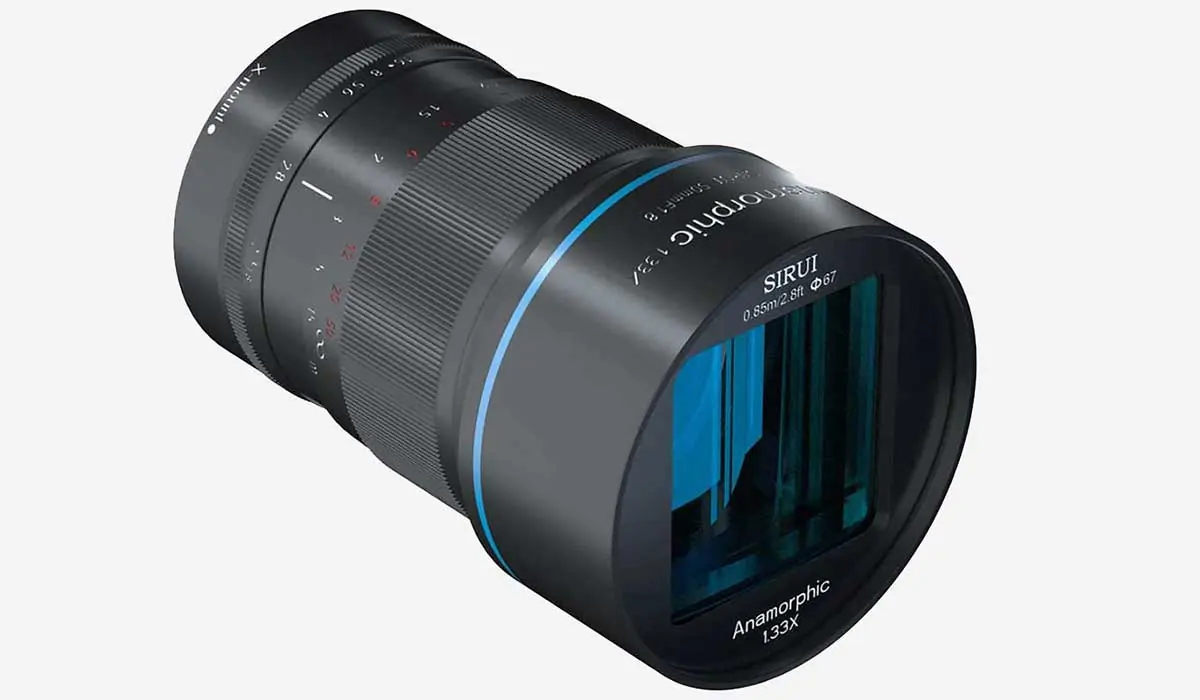
 Anamorphic Lens by Sirui
 Single Focus : Synchro Focus
 Mount: E, MFT, X, RF, L
This lens is a revolution to anamorphic lenses the same Blackmagic was a revolution to cameras a few years ago. It's not necessarily perfect (remember, the comparison is with Blackmagic), but it's got MANY features that we could only dream so far, in a very affordable product.
The hype around this lens started back in September, when it modestly showed up at IFA in Berlin. From there on, as people picked up on it, the interest kept on growing until mind-boggling levels affecting the sales of adapters on eBay. Everyone is holding onto their money before committing to adapters now, because the Sirui might be able to deliver what we need.
The lens is tiny but heavy for its size, weighing 570g (1.25 lbs). Construction feels pretty solid, no plastic parts. Filter threads are 67mm. Both aperture and focus rings offer good resistance and smooth rotation. Aperture ranges from f/1.8 to f/16. Focus features markings in both meters and feet, and it goes from 0.85m (3ft) to infinity in 140 degrees of throw. The biggest thing here is that you only need one focus ring (this might sound like an alien comment if you're not used to anamorphic adapters). Operate it as regular lens, yet get anamorphic vibes.
Squeeze is 1.33x, which is a great call for today's default 16:9 camera sensors. All you need to do is desqueeze your image in post and you'll have a vintage Cinemascope aspect ratio of 2.36:1 - storytime: after 1973, Cinemascope has been extended to 2.39:1 or 2.4:1 by eliminating the optical soundtrack from the film print.
The lens comes in three different mounts at the time of release. E-mount for Sony, MFT for Panasonic, Z-Cam, BMPCC4k and others, and X-mount for Fuji. Before anyone starts complaining about EF mounts, this lens was clearly designed for mirrorless cameras. The EF mount requires 44mm between the mount and the sensor (that's called flange distance), while e-mount only has 18mm. If a lens is designed for a shorter flange, it can't be adapted to a longer flange.
The image circle is APS-C, or S35. It doesn't cover full frame - same thought process of the mount. Keeping this lens with a smaller image circle than FF and mirrorless mounts is key to manufacture and distribution at the price we're seeing.
This lens is crisp beyond what I thought possible. Razor sharp wide open from center to corner at minimum focus. It also does something I didn’t really expect: performance decreases as we focus towards infinity wide open. We see some chromatic aberration pop in the center and the edges get really smudged. Still beats all other 1.33x adapters out there and I wouldn’t say this is bad performance.
The label says 1.33x squeeze but I wanna make sure. So I shot three circles at different distances to check. I used diopters to force infinity focus and other distances to the focused object. The reason I did different distances is because this lens focuses through a technique called synchro focus - this means both the spherical and anamorphic blocks are being adjusted at the same time - and anamorphic fronts tend to get a lesser squeeze when close focused.
So while 1.33x squeeze holds true at infinity, when at minimum focus we're seeing more of a 1.26x
If you’re new to anamorphic shooting, you’ll find it pretty weird to frame and focus this squeezed image. If your camera doesn’t have a desqueeze function consider getting a small monitor that has anamorphic desqueeze. There are lots of options in the $200 range.
If you’re used to scopes already, 1.33x is a breeze. I can shoot like this all day long.
Looking at a checkerboard we can see the distortion profile is pretty controlled. 1.33x scopes only starts to warp for real around 35mm or wider.
Flares are sweet, blue and super saturated. Terrifically sci-fi. There's not much else to say about these guys!
The smooth oval bokeh gets lost pretty quick when stopping down, becoming a polygon due to a 10-blade count aperture mechanism.
A few folks have brought up the issue of skewed flares and footage, which means the anamorphic block is slightly out of perfect alignment. The lens doesn't offer any way of adjusting this from the get go, but my solution was to loosen up the mount a little bit and adjust it to perfection.
The other bit where this lens takes flak is coverage. Everyone goes crazy when a lens doesn't cover full frame, apparently. Well, this one doesn't. It's APS-C or S35. You know what else is S35? This badass LOMO from Van Diemen. Do you see anyone complaining about cine lenses not covering full frame?
Now that we compared the $700 lens to the $15000 lens, I feel we're at a good place for a conclusion. Let's start with the downsides.
While aperture is smooth, it could benefit from more blades - or curved blades - for a smoother bokeh throughout the entire range. This would prevent stretched polygons when the lens is stopped down and deliver only ovals.
The alignment thing is a bit off-putting. A stricter quality control for this would solve the issue and boost confidence for buyers. And since we're talking about the look of the lens, I guess Sirui could enhance the typography work on this thing. It looks super generic, not representative of what it stands for when it comes to anamorphic shooting.
So, what does it represent? This is a full blown revolution in budget anamorphics. It's groundbreaking. There has never been such a cheap and effective way to shoot scope since... ever, I guess - and I'm the expert! I don't think Sirui was aware of how much of an impact this lens is going to have in the anamorphic market, springing competition at a budget level we’ve all been dying to see for years.
It'll also drive down the prices of adapters and make shooters more demanding towards simplicity instead of hacked-together solutions. As I said in the beginning, this feels like what Blackmagic did for cameras a few years back.
The first Blackmagic camera was far from perfect, but they evolved into something amazing today. Here I think Sirui is doing a better job, starting at a higher level. Not perfect yet, but certainly on the way there.
This lens is gonna sell like crazy and drive even more interest into anamorphics. If Sirui stays on top of this, they can single-handedly explore this market before anyone else comes close.