
Stretch factor 1.33X
Coverage APS-C

Aperture f/2.8

Focus throw 190 0

minimum focus 1'11.6"0.6M

filter threads 72 MM

Weight 1.7lbs785g

size 4.9"12.5CM

get in on B&H
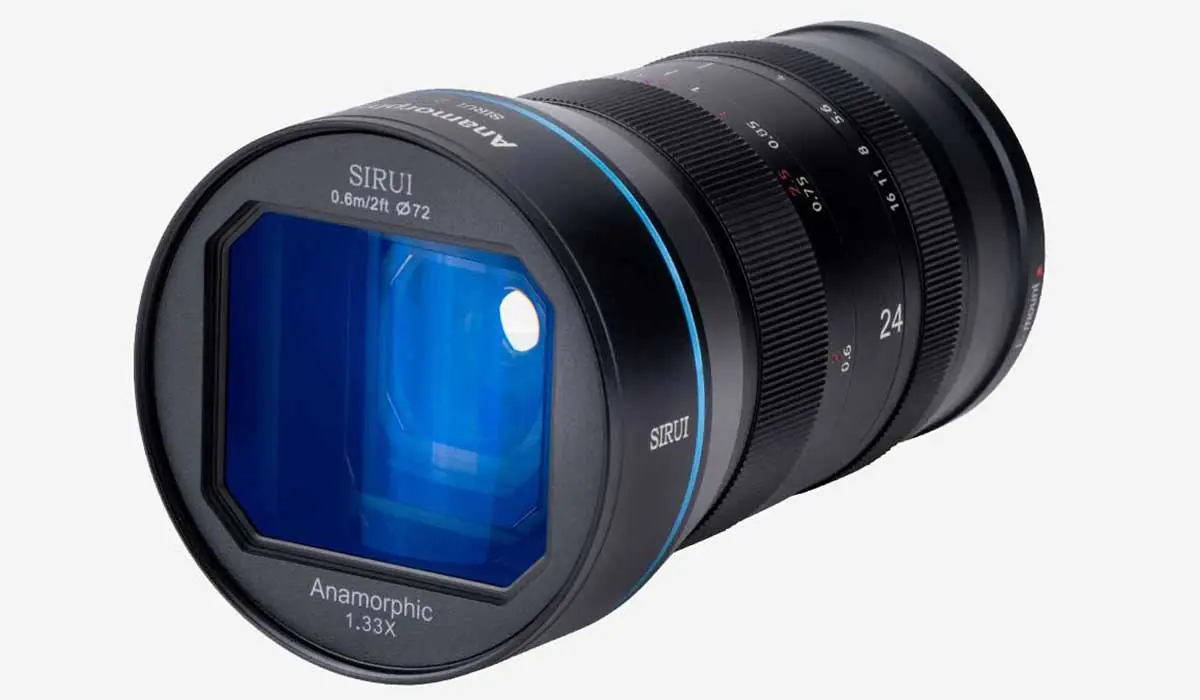
 Anamorphic Lens by Sirui
 Single Focus : Synchro Focus
 Mount: E, MFT, X, EF-M, RF, L, Z
All Sirui lenses so far offer 1.33x squeeze, which ends up on 16:9 footage stretching out to almost perfect CinemaScope straight out of the box. It’s a great squeeze factor to start with. The price on these things makes them extra friendly to beginners, as they also eliminate a lot of the elements of putting together a DIY anamorphic setup.
The 24mm is slightly bigger and heavier than its siblings, at 780g or 1.7 pounds and 12.5 cm or 5 inches. Filter threads are 72mm, bigger than the previous two lenses, and this one does not come with iris and focus gears, like the 35mm did.
This lens is also a bit over a stop darker than the other two, with f/2.8 as maximum aperture versus 1.8 on the other two, and it closes down to f/16. Wide angles are tougher to design and fast ones get expensive. Not the goal with Sirui, right?
My predictions about close focus were wrong, as the 24mm comes down to 0.6m or 2ft, almost a foot shorter than the other two lenses, adding some nice versatility and creative framing opportunities. Focus throw is just a touch longer than 180 degrees and features nice hard stops.
Talking about mounts, this gets a little confusing. The 24mm comes with five native mounts, but not the swapping system used on the 35 - which I thought was brilliant. The options are Sony E-mount, MFT, X-mount is back, Canon EF-M and Z mount for Nikon. Mine is in MFT as I believe that to be the most versatile one. On the risk of repeating myself - these lenses are NOT designed for EF mount. They will not work.
When we look at sharpness, we have similar behavior to the other lenses in the set, which is great. The 24mm performs great at minimum focus and looks a little softer at infinity. Stopping it down cleans it up even more, as expected.
I fully switched over to MFT in this last review and I find it’s useful to present the difference in focal length equivalences. Notice these numbers are slightly different for APS-C, or S35 coverage!
The 24 would become a 48mm thanks to the 2x crop of Micro Four Thirds, but thanks to the 1.33x anamorphic squeeze, it gives me a 36mm horizontal field of view.
The 35 would become a 70, and once we apply the squeeze, we get a 52mm field of view horizontally.
Lastly, the 50 would be 100mm, and thanks to the squeeze it turns into a 75mm horizontal field of view.
Notice that the vertical axis is still tighter, and that’s the whole point in anamorphics. Feeling you’re using a longer lens, but actually getting a wider field of view. A set with these fields of view - 36, 52 and 75 - is an excellent choice for most narrative work.
Flares are CRAZY in this 24mm. They feel super intense and due to the wide angle nature of the lens, it’s easy to get multiple flares in the same shot. I feel the threshold for flaring has been lowered on this one, making it easier to get a streak. As the rest of the set, they’re blue-purple.
For distortion, this being an actual wide angle helps distorting the footage.
An important thing to point out, still in the subject of distortion, is that squeeze changes across the focus range. It’s 1.33x at infinity, but once we get to minimum focus, at 2ft or 0.6m, the actual squeeze is 1.25x. This is a consequence of this focusing method. If you want to learn more about other focusing methods, hit subscribe now because I’m working on a video about that!
Overall, I’m pretty happy with this set, what we can do with it and - especially - how much it costs. I hope Sirui makes something a bit longer, like an 85mm, just to round it out and give us bokeh paradise. I miss the swapping mounts and gears that were used on the 35mm though.