
Stretch factor 1.42X
Coverage 40 MM

Focus throw 360 0

minimum focus 6'6.7"2M

filter threads 95 MM

Weight 2.0lbs900g

size 4.5"11.5CM

get in on eBay
 Anamorphic Adapter by Isco Precision Optics GmbH
 Single Focus : Variable Diopter
 Mount: 77 MM
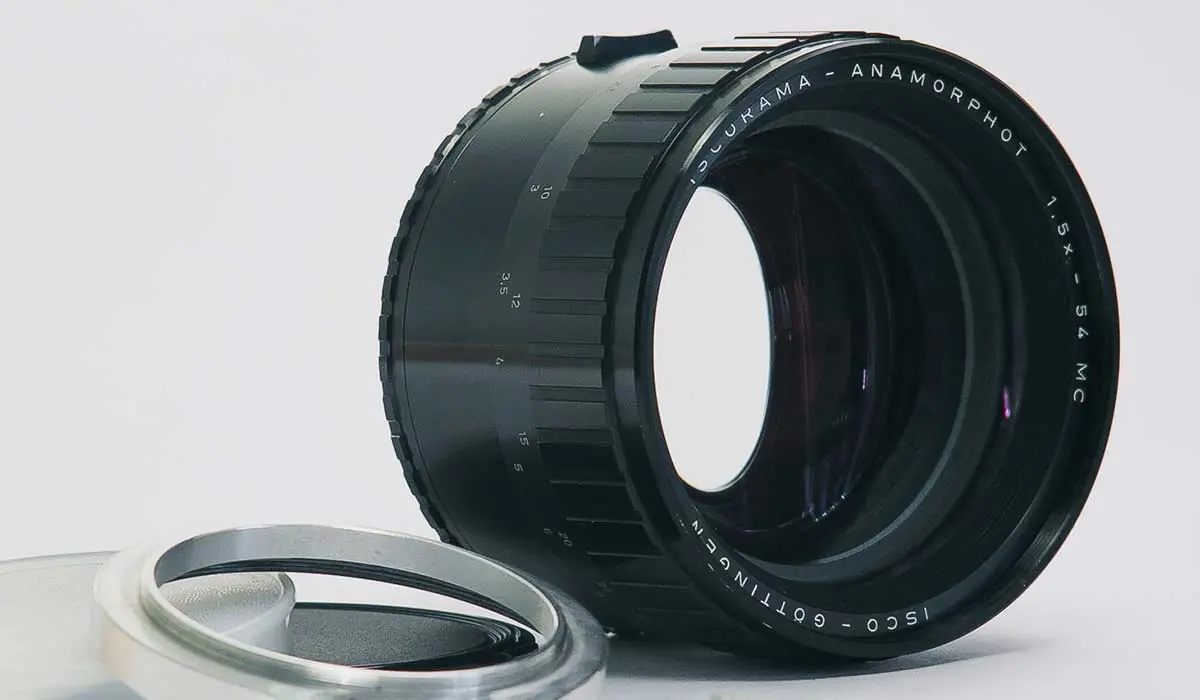
The almighty Iscorama 54! Released along the Iscorama 36 in the late 70s, the 54 is the biggest and heaviest member of the Isco family.
It weighs around 950g, has a full metal housing and a smooth focus ring. The alignment mechanism is very simple, just press the button near the back and rotate it until it’s oriented properly.
What sets the Iscoramas apart from the other anamorphic adapters is their single-focus mechanism based on a variable strength diopter that acts as the focusing mechanism. All you gotta do, when using an Isco is set your taking lens to infinity and do all your focus work directly on the Iscorama’s focus ring.
The name “54” comes from the diameter of the rear glass of the lens. The same goes for 36 and 42. Their stretch factor is 1.5x and focus ranges from 2m to infinity, with a nice and – maybe too – long focus throw (near 180 degrees).
As the Iscoramas were developed for photography, they have standard filter threads on both front and back, making life much easier because you don’t need to worry about finding (or making) very specific clamps. A couple step rings will work just fine. This is what I have here, a 77mm blank and a 72-77mm step up so I can attach it to the taking lenses. The front thread measures 95mm, which is a big size in order to find decent diopters.
Available 95mm options are the Focar A (+1) and Focar B (+2), or you can use step down rings to reduce the size to 82mm or even 72mm without too much vignetting.
On the Mir 1B, besides all the vignetting, we can see a lot of softness around the corners but very little chromatic aberration. We can also notice the difference in compression around the edges, giving the image a bent look.
Softness around the corners is much better on the Helios, because it’s not as wide and doesn’t get that lower quality area of the glass onto the sensor. I don’t know if it’s my copy, but the Jupiter 9 performs amazingly well with any of my scopes and the Isco 54 is no exception. The Tair 11 is the one that shows most improvement when stopped down, being very soft at f/2.8 with a blueish ghosting aberration that is completely gone at f/4
Since I had the chance, I decided to do one last extreme test at f/1.2 using the Canon 50mm L Series at the Isco’s minimum and maximum focus settings thanks to diopters.
At minimum focus, things are hard and quality drops fast from the center. It improves at infinity, but not much.
This version of the 54 is MC, or multi-coated, which improves light transmission and reduces optical artifacts, which, sadly, include flares. There are single coated versions of this lens around the world, but they’re much harder to find. For the flare test I tried the Helios 44 first, but this lens flares way too much by itself and I was unable to identify the Isco’s flare among all the bouncing light.
Using Canon’s 50mm f/1.2L got me better results since it allowed me to isolate the Iscorama’s flare, this thin and faint blue line we almost don’t see. Multi coated Iscoramas have a little less charm, as we expected.
When checking the widest possible taking lens I cropped the sides of the footage to achieve a 2.4:1 aspect ratio, the standard Cinemascope proportions. Even then I was unable to have a clean frame with the Mir-1B at 37mm, presenting heavy vignetting on the sides.
If I want to cover the entire full frame sensor for a 2.66:1 aspect ratio the widest pick is indeed 50mm.
Being able to rack focus just using the Isco speeds up shooting immensely. This, combined with good image quality even at large apertures eliminates the need for a tripod and allows me to be always moving around when shooting, being a good setup for run and gun.
Minimum focus at 2m is kind of limiting and changing diopters on the fly wasn’t one of my most comfortable experiences of late. It’s less troubling if you group your shots based on their diopter needs or set your focus range within a single diopter, like the +0.4, maxing out at 2.5m.
On the bright side, you become crazy good eyeballing when things are closer than 2m.
| Front Glass Size: | 86 MM |
| Rear Glass Size: | 54 MM |