
Stretch factor 2X
Coverage 65 MM

Focus throw 330 0

minimum focus 4'11.1"1.5M

filter threads N/A

Weight 0.7lbs300g

size 3.7"9.3CM

get in on eBay
 Anamorphic Adapter by Schneider
 Double Focus
 Mount: N/A
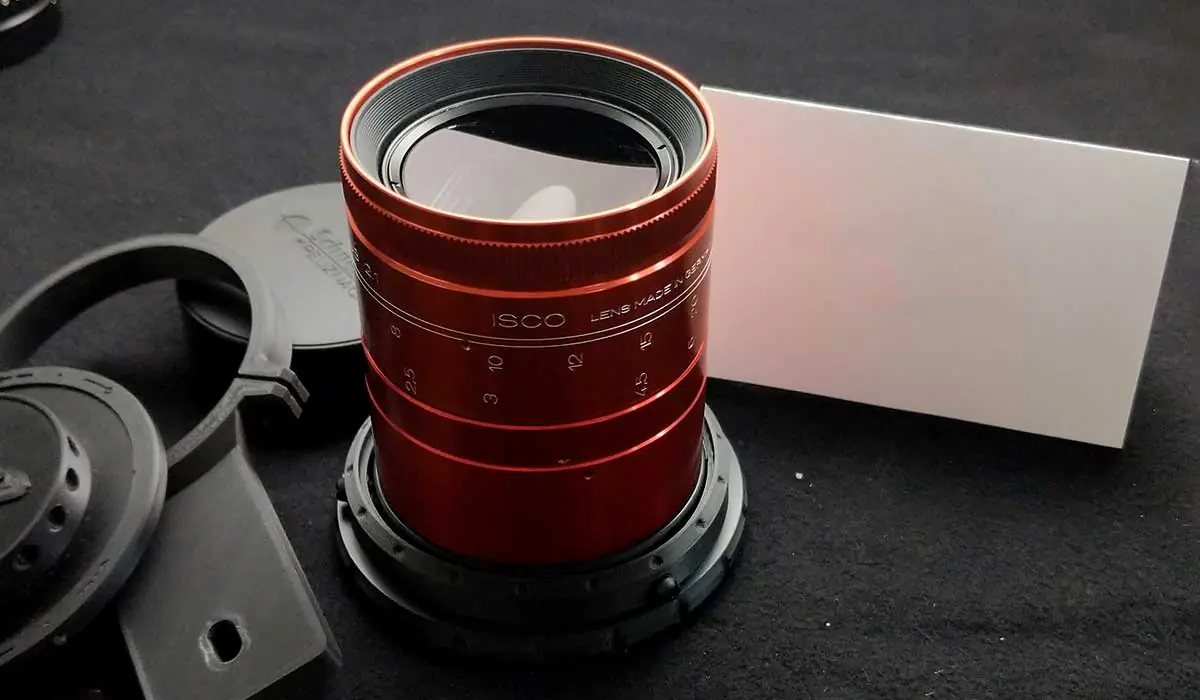
Canon 100mm Macro collar is a perfect lens support. Markings in meters and feet. Recessed front. Non-extending body
There are three different versions:
- Studio: the first generation, has indents around the front.
- Gold: Optically identical to the “studio” but smaller in diameter.
- Red: Identical size to the Gold one but with cleaner coating for even less flares.
If I had to define this lens in one word, it would be "sharp". The modern glass and coatings grant you edge to edge performance at the expense of flares. You'll see almost none of them. The other advantage of such sharpness is that you can go as fast as you can with your aperture with no disastrous image degradation. Oh, and no distortion either. Low light performance is quite nice, and due to the high quality of the glass, you can really see the oval bokeh.
Let's begin by saying that the Isco on the name of this adapter is the same Isco from the Iscoramas, only a few decades later, so the quality is there - but the single focus is gone. These lenses are designed to pair with film projectors. Some of them come with a taking lens attached, and that can be tricky to take out, so do it with caution.
This adapter weighs 300g, which is lighter than I expected. Stretch is 2x, so you'll have lots of compression going on and super oval bokeh. You have to rig it with clamps in order to attach diopters to it and to attach it to a taking lens. The clamp is also the way to align this adapter properly.
One thing I had no idea about this lens is its push-pull focus lock. When you push the ring down it won't budge. Then you have to pull it forward in order to adjust focus again. I guess it is a useful feature when dealing with projectors, since the distance will never change! Anyway, that was just an interesting thing I had never heard about.
For many reasons, I'm not a fan of projection lenses. Double focus is too time consuming - which is why I'm using the HardCoreDNA -, and the setups tend to grow too long and too front-heavy. All of this applies to the Ultra Star.
As I said in the beginning, "sharp" is the word to define this adapter. Not Iscorama-sharp. I mean Zeiss sharp, Canon L sharp. Tack sharp at f/1.4. It follows the performance of the taking lenses impeccably and I can't spot blooming, washing or any of those pesky vintage artifacts.
For flares, the Ultra Star behaves similarly to the Cinelux. Very subtle green flares, usually caused by strong light sources. The Red version has even less flares due to stronger coatings. You can always try to cheat your way around it and increase flares by using UV filters.
The early version of the Ultra Star - with the little notches around the front - has a deeply recessed front element and incredibly red coatings. The reason I'm adding this bit herer is because under the right circumstances, this first version flares.
I was able to get insanely red flares out of it, but only when light hits in a specific way - close to the lens' edge. I wish the front element wasn't hidden as deeply, so it would be easier to get these flares out. My regular flare test only gave the tiniest bit of a red kick. So if you want an Isco that has the possibility of flaring, this one is a good candidate!
Canon's 40mm pancake isn't enough to clear a 2.4:1 frame, but surprisingly, you'll be fine with a 50mm on Full Frame. Then 2.66:1 at 58mm with the Helios 44, and full 3.56:1 above 70mm - commonly 85mm. I wasn't expecting to go so wide for a Cinemascope crop. It was a nice surprise. Take into account that a single focus solution will increase vignetting and all of these numbers.
The Isco Ultra Star made me swallow my dissatisfaction with this type of adapter - modern projection lens. Its compact form matched by unmatched optical performance creates a powerful piece of gear. I was able to go wider than I expected, handling the lens is easy and the anamorphic look is there. Not the flares, true, but for the people who aren't after flares, this is like a gold mine (pun intended). Now I understand all the praise for this adapter, when it comes to beginner anamorphics. And it can be had for cheap too!
| Front Glass Size: | 48.75 MM |
| Rear Glass Size: | 43.6 MM |