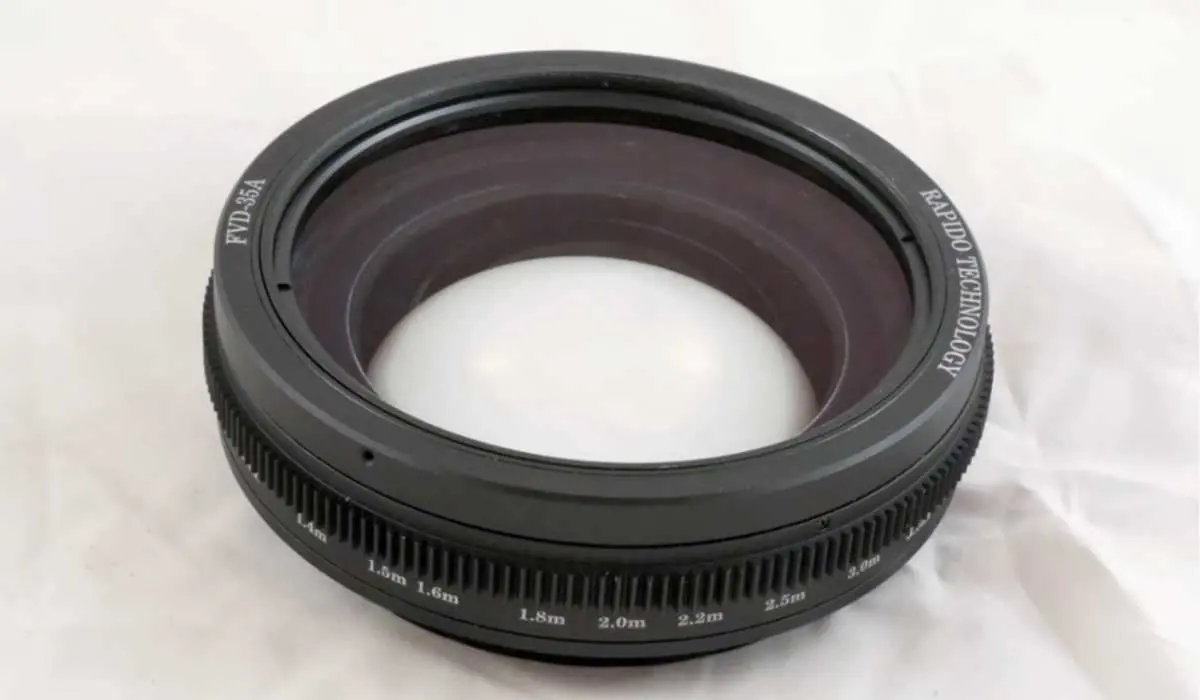

Wide angle factor 1X

Focus throw 120 0

minimum focus 3'3.4"1M

filter threads 115 MM

Weight 2.4lbs1.1Kg

size 2.0"5CM

get in on WWW
 Focuser by Rapido Technologies
 Single Focus : Variable Diopter
 Mount: M75
The FVD-35A is designed for 35mm projection scopes - just like the 16A/B are designed for 16mm scopes. This thing is massive.
In terms of usability, the sheer size of this thing wasn’t as troublesome as I expected it to be. Racking is smooth and assembly was pretty easy. Image quality follows the trend established by the 16A, which is almost no noticeable loss.
The 35A is another offering in variable-strength diopters, turning double focus systems into single focus. What makes it unique is its size. This thing can easily cover scopes that would usually vignette with smaller focusers. Since we’re on the subject of size, the glass on the FVD-35A measures 92mm for the rear element and whooping 112mm for the front. The threads on the back of it are 95mm and the front is threaded with 115mm.
The rear threads are much bigger than the default 75mm used on the Rectilux HCDNA and Rapido’s FVD-16A. So you need a 75 to 95mm adapter ring to mount the 35A onto a Rapido FMJ. This adapter is sold separately for $40 and I almost missed it. You can also get a custom-machined adapter that locks onto the front of your scope directly for $85.
On the subject of focus, the FVD-35A can focus as close as 1.1m or 3 foot 6 in front of the lens, with witness marks in meters. This measurement is NOT from the reference sensor mark on the camera. Because of how variable diopters work, the minimum focus for these guys is always measured from the front of the system. Focus throw is 190 degrees, canon style, and the whole thing extends while focusing, changing its size from 46.6mm to 57mm, so a 1cm increase. On the upside, the front does not rotate while focusing and it already comes with focus gears!
I also noticed that some grease comes out on the sides, especially during the first uses. If you wipe this away, the leak is reduced until it's gone.
Adding the FVD-35A to your setup will up your load by 1.1 kilograms or 2.4 pounds, which is a hefty increase. The lens comes in its own pelican case, which is filled with various pieces of foam. The front cap feels pretty flimsy too, while the rear is a standard 95mm cap.
When it comes to sharpness, you can really see the 35A is optimized for 50mm lenses. The performance there is best, and it drops as we move into longer taking lenses. It's interesting to see that the corners perform best at fast apertures and get worse as we stop down the system. If anyone knows why that happens, I'd love to hear from you in the comments.
Talking flares, once we add the 35A to a setup, we can see that those nice blue coatings add a blue streak to the picture. Veiling glare isn't affected though, which is great.
Rapido’s website says the FVD-35A covers a 45mm taking lens with a 2x scope on full frame. Vignetting is a non-issue. For my tests coverage was limited by the scope itself. We're looking at the Black Schneider Cinelux by itself on a 50mm, and this is it with the 35A. No changes. A little bit of framing changed as I added the lens. So let's quickly go through it on 35mm, only good enough for MFT sensors, 50mm almost clears 2.39:1 and 85mm is all good. Definitely one of the strongest aspects of this FVD.
Breathing is not super pronounced, at least not nearly as much as many scopes or the Pfocus I reviewed two weeks ago. You still get some vertical stretching and compressing, but in a much lesser degree.
And last, variable diopters usually have a wide angle effect on the system. I was quite surprised to see that this is not the case for the 35A. Looking at a naked 50mm + Cinelux, the field of view has no changes when compared to the system with the 35A on top! This definitely has to do with the lesser breathing!
I find this to be an awesome addition if you’re not running and gunning all the time. If you are shooting handheld all the time, you better get stronger than me to put up with it! Alright, it is NOT that hard to be stronger than me.
The 115mm front makes finding filters a bit more challenging and expensive than all other focusers. If you have the space by shooting mirrorless, I’d say look for a filtration system that fits between your taking lens and your camera mount, like Fotodiox and Breakthrough offer.
In terms of things that can be improved, custom-cut foam would increase the perceived value of this piece of gear. You’re paying over a thousand bucks for it. It comes in its own case, that feels nice, but then it looks cheap when you open the case and find a bunch of random pieces of foam. Last, the front cap could also be improved. It feels a bit like a repurposed yogurt top.
| Front Glass Size: | 112 MM |
| Rear Glass Size: | 92 MM |