
Wide angle factor 0.9X

Focus throw 180 0

minimum focus 3'3.4"1M

filter threads 86 MM

Weight 2.2lbs980g

size 3.8"9.6CM

get in on WWW
 Focuser by Rapido Technologies
 Single Focus : Variable Diopter
 Mount: M75
The FVD 16B is a fairly new focuser by Rapido Technology, launched in mid 2020, covering a shortcoming of all other focusers. It costs a hefty thousand bucks and you can order it directly from Rapido’s website.
If you look at the FVD 16A product page, you’ll see a line that says “Image Quality: Optimized for 50mm f/2 taking lens”. And a lot of people either don’t read this chart or don’t understand what this line means.
All variable diopters are optimized for a certain focal length. That’s their ideal working condition. So far, all focusers on the market have been optimized for a 50mm taking lens. Rectilux, Rangefinder, FM Lens and even Rapido’s “A” models. This is why you start to see image degradation as you push towards longer taking lenses like 85, 100 or 135 - typically the worst.
That’s because these focal lengths behave wildly different than a 50mm. Their tolerances are smaller, their depth of field is shorter and their whole optical design is entirely different - 50mm lenses tend to use a Double Gauss design, or a modified Double Gauss, while telephotos go about it differently.
Long story short, you need a different design for your variable diopter if you want to keep top notch performance shooting with longer lenses. That’s the FVD-16B. The same line now says “Optimized for 100mm f/2 taking lens”, and you’ll see that the difference shows.
When using long focal lengths and close focus on the variable diopter, the 35A has a lot of blooming and softness, the 16B is tack sharp.
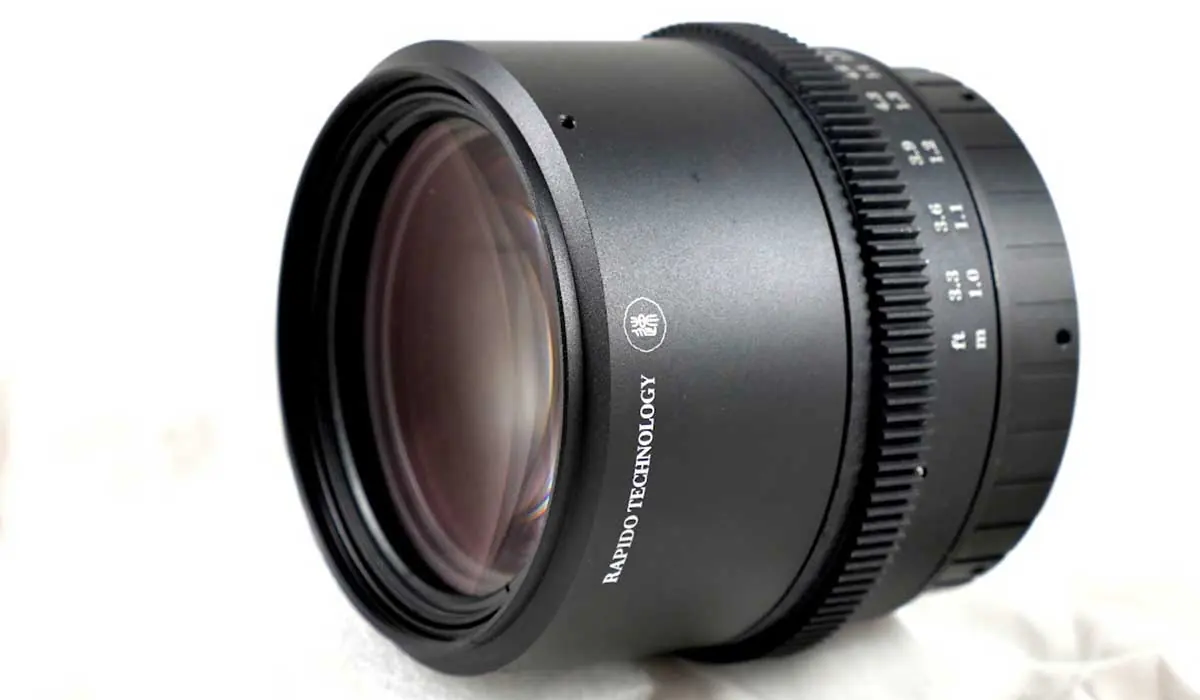
The FVD 16B is a very strange lens, looking like an empty tube. It has 75mm female threads in the back so it can mount onto a Rapido FMJ, and 86mm threads in the front for filters.
Focus comes down to 1m, or 3 feet, over 180 degrees of throw, with standard gears on the focus ring. The lens does not rotate or extend while focusing, and this non-rotating non-moving front is the reason the lens looks like an empty tube, almost 10cm or 4 inches long.
The distance between the two glass elements in this lens is much greater at close focus than the distance in the other focusers. This makes me think that the positive and negative diopters in this focuser use a lower power in comparison, and that’s why the long lens body and travel.
The 16B comes with regular front and rear caps - no yogurt tops on this one. It weighs 1kg, or 2.2 pounds and it really cranks the leverage on your lens mount if you don’t have proper support. I have to say, this whole thing looked a almost ridiculous to me. The 135mm lens is already long, the scope is long and the focuser is also long, giving me a camera with a pipe in front of it.
The focal length cranks up our perception of rolling shutter, and it was very easy to get wobbly images. If you have a global shutter camera, you won’t have this issue. Peasants like me still struggle though. It was hard to carry this thing around and having the focus ring all the way at the front made it pretty awkward to operate.
But when shooting on a tripod and not flailing around, the 16B performance was shocking.
It turned out to be super sharp across all focal lengths, with excellent performance in the center and even decent corners shooting wide open, only improving when stopped down. Why not use this thing for all taking lenses then? Well, I’m glad you asked.
The body of the 16B introduces massive vignetting. 50mm is only usable on a crop sensor, not even 85mm clears 2.39:1 on full frame, which was shocking to me, but 135 is finally vignette-free and sharp in all its glory.
To demonstrate breathing I did some rack focusing on the 85mm and you can see that the field of view expands considerably when going to close focus. At close focus, the FVD 16B operates as a 0.9x wide angle adapter when compared to infinity focus.
The neutral coatings don’t influence the flares, here you can see the Elmo II with an 85mm taking lens, and then with the 16B on top. No extra streaks or bubbles. Good stuff.
So, what do I make of this focuser? If you’re always going for longer lenses, the 16B is an absolute must. The difference in performance is astounding and I had the feeling this thing made my setup of 135mm plus scope sharper wide open than the 135mm lens by itself when wide open.
If that’s not the case, you can save your money and stop down your longer lenses when you shoot with them. I’ll admit I would be way more tempted by this thing if it cleared 85mm on full frame. The FVD 16B feels like a specialty product in a specialty niche. I think it’s a success if you’re aware of the limitations. This is not an all-rounder focuser. It’s a focuser that works in one specific situation.
It’s definitely the one I’d grab if I were to... rehouse this whole setup together and make things tighter. Having it sit in front of an already long setup stressed me out, but if you got trust on your camera mount… Rails are a must for me.
| Front Glass Size: | 77 MM |