
Stretch factor 2X
Coverage S35

Aperture T2

Focus throw 270 0

minimum focus 1'8.9"0.53M

filter threads N/A

Weight 5.3lbs2.4Kg

size 7.4"18.9CM

get in on WWW
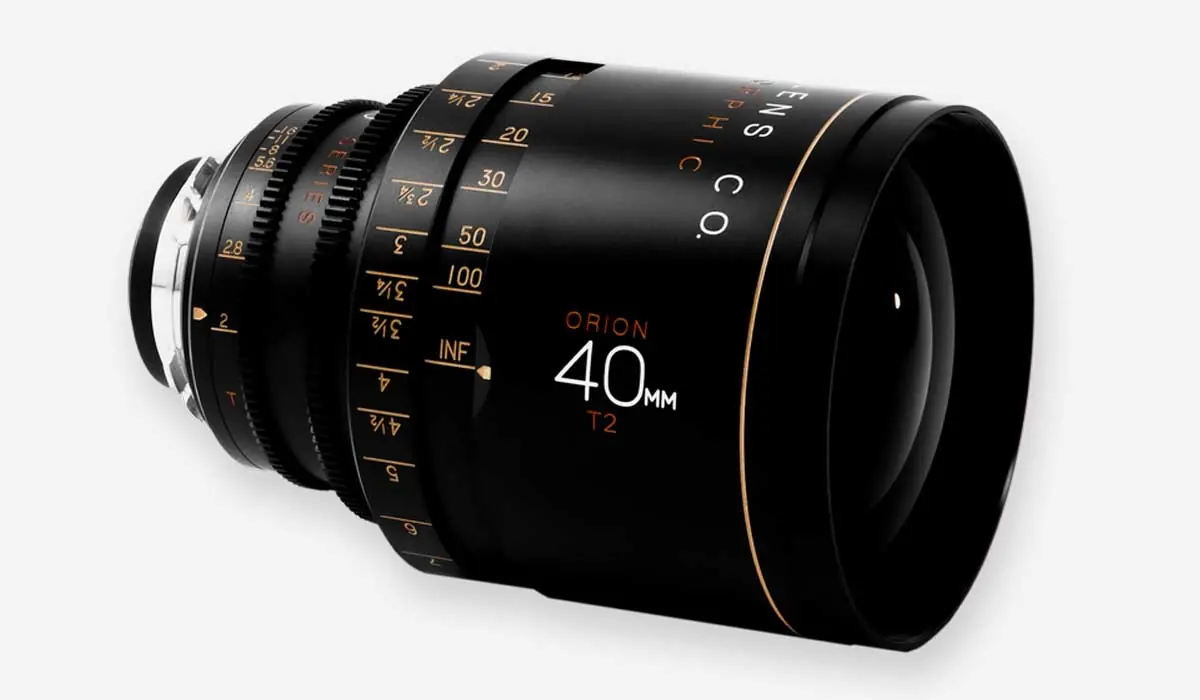
 Anamorphic Lens by Atlas Lens Co.
 Single Focus : Variable Diopter
 Mount: PL, EF
I am unable to lie: I had a blast shooting with the Orion 40mm. This was actually my first time using a proper cine anamorphic lens and it changed many things on how I perceive anamorphic shooting. First of all, 40mm with 2x scope is incredibly wide. I am used to shoot with both eyes open – one eye in the viewfinder for focusing and the other eye on my surroundings for moving around. This was the first time I felt a lens was just as wide as my natural field of view.
One might think a wide angle is good for establishing shots but the close focus capabilities of this lens allowed me to make some of my most interesting close up shots, showing a fair amount of background along with my subject.
I shot all the footage using both the Sony A7s2 and Panasonic GH5, and while the GH5 has its own anamorphic mode, the Sony offered no support, making an external monitor key to framing. Due to gear incompatibility and form factor (I wanted to stay as small and light as possible) I ended up shooting everything handheld. Handheld as in camera + lens + (sometimes) monitor on the hot shoe mount.
This made for some really shaky shots every once in a while, a huge arm workout, wobbliness in some of the footage, and the ability of stuff the camera in my backpack when I was not shooting. Not to mention every rack focus shot was a finger workout.
Even though the lens can go to T2, I found my sweet spot to be between T2.8 and T4 for best out-of-focus areas and decent sharpness that I could boost in post-production without hurting the footage.
If I had the money right now, I would not bat an eye investing in one of these. Even among the whole Orion lineup I feel the 40mm is the most versatile and interesting focal length. I shot for full two weeks with it and never felt I needed a longer or wider lens.
What are the downsides of the Orion 40mm then? Some people claim it is a really soft lens, but that was not my experience. Sure, at T2 things get a bit mushy, but no lens is super sharp wide open. I was doing great at T2.8 and I feel the lens loses its magic past T5.6 because the background starts to blend with your subject in terms of sharpness. Bokeh feels strange at times and flares are quite saturated. Those two aspects do not bother me, but they might be red flags for other shooters.
The first thing I noticed when I picked up the case with the lens is that this baby is HEAVY. It is a solid cup of metal filled with thick slabs of glass. At 2.2kg (5lbs), the Orion 40mm made both the Sony A7s2 and Panasonic GH5 feel like little toys.
Not only heavy, the lens is also pretty big: 18.9cm (7.4″) in length with a 114mm (4.5″) front, a standard value for cinema lenses, making it compatible with countless filters and matteboxes. The gigantic front made me work extra hard to find perfect lighting, unable to rely on a variable ND.
Speaking of adapters and lens mounts, the Orions come in PL mount by default, with an optional EF mount at extra cost. The one I used was already fitted with an EF mount. If you are swapping mounts you will end up using a handful of shims (provided by Atlas Lens Co.) to adjust your flange distance properly. I have heard from a few different sources (including a rental house) this is a time consuming challenge, especially because it is hard to spot critical focus when the lens is wide open and tell if you have the perfect distance between the lens mount and the camera sensor.
Focus goes from infinity down to 0.56m (2ft) at minimum focus, with 300 degrees of throw and markings in both feet and meters. Iris ranges between T2 and T16, featuring 14 aperture blades for smooth bokeh. As one would expect from a cine lens, both rings are geared for motors/follow focus. The lens does not change size while focusing since all the movement is internal, that also means the front does not rotate, which is great (#iscoramaFlaws).
There is a fair amount of focus breathing, widening your field of view by about 5% when focused at infinity compared to minimum focus. It is not a big deal on most shots, but if you have a big rack focus you will definitely feel it. 5% at 40mm 2x Anamorphic is a pretty big deal as you can see.
At T2 the Orion is quite soft but you can still tell critical focus and read small text even 3m away. There is lots of blooming on all highlights in the center, intensified by purple fringing on high contrast edges. The blooming and fringing dials down towards the edges, where we see the usual loss of sharpness and considerable light falloff – about a half stop. The text is still pretty readable though.
As we stop down to T2.8 – which is my favorite stop for this lens – the blooming goes away and the purple tinge is put under control. The image is not as sharp as T5.6 or 11, but calling this lens soft at this point seems like ignorance. The corners are still quite unsharp, not much improvement over T2, and just a bit darker – less than a quarter stop. The subtle light falloff and softness in the corners at this point contribute to creating mood in the shots, narrowing attention to the subject and not to over-detailed corners.
Speaking of detail, the lens is sharp from T5.6 onwards. Corners improve noticeably with just tiny smudges at the very edges and very little light falloff. Not much changes as you stop down from there, as we can see from T11. Sharpness still goes up a touch, making it sharp edge to edge and light distribution across the frame is the biggest difference at this point, with much more uniform values from center to corner. The one odd thing is, at minimum focus (0.6m) we start to see yellow/blue fringing on high contrast edges at the corners of the frame which were not there at faster stops and are not quite visible when the lens is placed further away.
With a horizontal field of view equivalent of a 20mm lens, it is expected that the Orion 40mm shows some warping on straight lines. Anamorphic distortion is a big deal and it greatly contributes to making shots more immersive, creating an extra layer of depth onto a two-dimensional image. Below is an animated grid going from rectilinear to the the Orion’s distortion profile. Notice how the vertical lines have very little movement compared to the horizontal ones.
The Orion’s streak flares are a rich, saturated blue which, honestly, is a stone’s throw from SLR Magic’s flares. I like it because this blue is such a specific hue it can easily be picked in post-production and adjusted to my liking – including color changes to some extent. You can also see some teal elements reflected in there as well as a short vertical streak that adds more dimension to the overall anamorphic flare.
The blue gives good sci-fi vibes – since sci-fi and blue flares are in a tight knit connection since Alien (1979). We also see some rainbows when the light source is up close to the lens and, all in all, blooming is pretty controlled for having a light source pointed directly at the lens.
On such wide angle, the flare becomes smaller and smaller as I walk away from the camera, meaning that if you want bigger flares from far away you should work on getting some big and strong light sources (did anyone say M18?).
When I was testing for bokeh looking at a Christmas tree, everything looked great. But I noticed it can have a strange shape at times – I like to call it snowman bokeh, although it looks more like a bell-shape – and you can see it in the video at the top of this post between 0:35 and 0:55. I do not know what causes it. In other scenarios, as bokeh approaches the edges of the frame it starts to get cut off into triangle and bean shapes.
From my empirical observations, this has to do with the placement of the highlights and the focused distance. On close-ups these strange shapes almost never show up, but as soon as I started to get further from my subject, bokeh would get messy.
All of this to say that you can get amazing bokeh with the Orion 40mm – but you can also end up with some less-than-perfect ovals. Speaking of ovals, I noticed the stretched bokeh is not quite oval. Here is a quick comparison between the lens’ actual bokeh versus what an oval would be. If anything, the Orion has even more streched out-of-focus highlights, contributing for extra waterfall effect and subject separation.
According to the data sheet on Atlas’ website – also shown at the beginning of this post – the Orions cover a 31mm image circle. What does that mean? In quick terms, it means you are fine shooting with any S35 sensor (24.89 x 18.6mm), ARRI Alexa, all the way up to the 4:3 3.4K Open Gate mode (23.76 x 17.82mm) and RED Gemini (30.72 x 18mm), 5K 6:5 Full Height (21.6 x 18mm), the best RED camera for anamorphic shooting.
In my situation, the GH5 was absolutely fine with the 4:3 Anamorphic Open Gate mode even with the focal reducer attached. The interesting bit was to realize I could shoot fine on the Sony A7s2 if I was outputting a 2.40:1 crop using the center of the frame.
After a few days of looking at clips, creating distortion maps, analyzing flares and bokeh, drawing diagrams and interpreting charts, I like this 40mm better than when I had only my thoughts.
I can now notice and point out hard evidence of features I love about this lens and also be on the watch for its limitations. I am pleased by its distortion and focal length – 40mm is unattainable with 2x adapters. It allows for very strong compositions. Bokeh could be cleaner when we look at the snowman and triangular shapes and, if I am to be very nitpicky, flares could be less vivid for a “straight out of camera delivery” type of situation.
It is unfair to compare a cine anamorphic lens to adapters but I will do it anyway! The amount of time and stress I saved by having a single piece of gear to connect to the camera and head out to shoot made a huge impact on the images I produced. You can look at my previous videos and the tests on this post to compare. I had time to get perfect exposure, I was able to plan a shoot for magic hour and actually get it, I shot some pretty spontaneous stuff too which would have been impossible had I spent ten minutes fiddling with an adapter rig.
I know I am not the only one that struggles with adapters, especially at the beginning of any shoot and this is where cinema gear makes a difference and justifies its price tag. Skip alignment checks, clamp quirks, diopters and skip triple testing that every piece of the optical chain is in focus (check infinity on taking lens, check infinity on anamorphic, check focus on variable strength diopter). All of these things are already built into the Orion – or any cine lens for that matter.